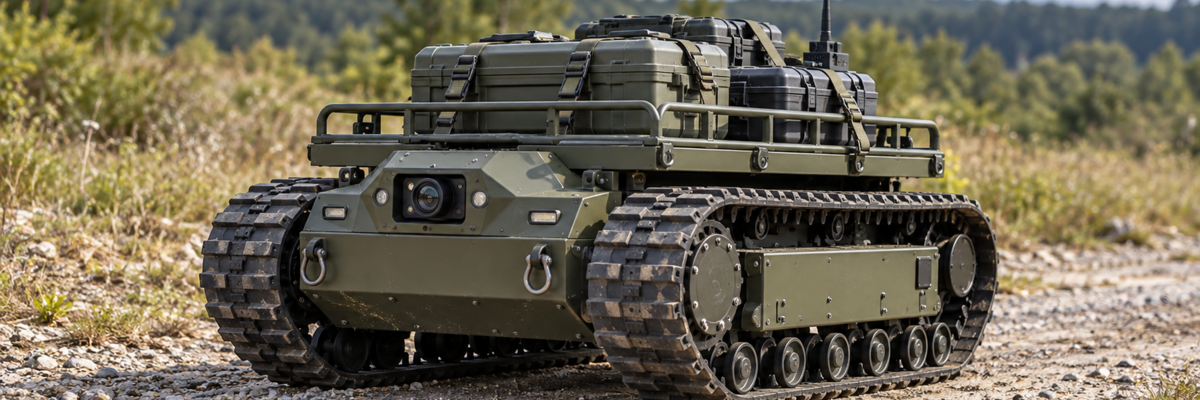
A UGV is an unmanned ground vehicle: a mobile platform that performs tasks on the ground without an onboard driver. A complete UGV system includes the vehicle, control equipment, communications and other necessary components. Depending on its design, it can transport cargo, support casualty evacuation, conduct observation or perform specialised engineering work.
A ground robot is typically controlled remotely by an operator. Some models support automated functions, but the term “UGV” does not itself mean that a vehicle can navigate and operate independently of human input.
What Does UGV Mean, and What Makes It a Complete System?
In Ukrainian publications about unmanned systems, the abbreviation НРК stands for “наземний роботизований комплекс”, meaning a ground robotic system. Related English terms include “unmanned ground vehicle”, “ground drone” and “robotic ground platform”.
These terms are closely related, but they emphasise different aspects of the equipment. A platform is the vehicle itself, including its running gear and drive system. A complete system also includes the equipment needed to control the platform and carry out its tasks. A photograph of a wheeled or tracked robot therefore does not show everything required to operate it.
English-language documentation commonly uses the abbreviation UGV — Unmanned Ground Vehicle. When comparing products, check whether the manufacturer is describing the vehicle alone or a complete package with a controller, communications equipment, power supply and task-specific equipment.
What Tasks Can Ground Robots Perform?
A UGV’s purpose depends on its platform design and installed equipment. One vehicle may be intended primarily for cargo transport, another for cameras and sensors, and a third for specialised engineering operations. The versatility of a particular model should be supported by its documentation.
Cargo Transport
Logistics platforms are designed to transport equipment, supplies and other cargo. Their capabilities depend on payload capacity, cargo bed dimensions, terrain capability and available energy.
Casualty Evacuation
Specially equipped systems can be used to transport injured people. This requires a manufacturer-approved configuration: sufficient payload capacity alone is not enough.
Observation and Inspection
Cameras and other sensors gather information from a ground-level viewpoint. The system’s capabilities depend on its sensors, field of view and data transmission quality.
Engineering Work
Specialised robots are used to inspect hazardous objects and perform certain demining operations. These tasks require suitable equipment and trained specialists.
Weapon-equipped systems also exist. These are specialised configurations; remote control alone does not make every ground robot a combat system.
The use of ground robots for logistics support and evacuation is described by the Ministry of Defence of Ukraine. Another example of platforms configured for different purposes is Milrem Robotics’ THeMIS family, which includes cargo, observation, engineering and other variants.
What Are the Main Components of a UGV System?
Designs vary between manufacturers, but several main components help explain how these systems work.
- Mobile platform. The body, wheels or tracks, drive system and running gear. These determine how the vehicle moves and what loads it can support.
- Power system. Batteries or another energy source incorporated into the design. Power is needed both for movement and for onboard equipment.
- Onboard control system. Electronics and software that process commands and control the vehicle’s components.
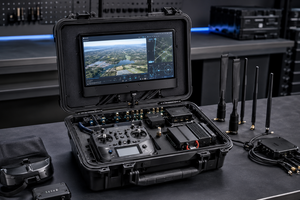
- Communications equipment and operator station. These transmit commands and provide available information about the platform’s status.
- Cameras and sensors. These help monitor the surroundings and equipment operation. The sensor package depends on the model.
- Payload. Cargo or equipment carried for a particular task, such as observation equipment or a specialised working module.
A modular design allows different equipment configurations, but it does not imply compatibility with every device. Weight limits, mounting requirements, power supply and software integration must be checked for the specific platform.
Wheels or Tracks
Wheeled and tracked running gear interact with the ground differently. Vehicle weight, ground contact area, ground clearance and drive design all influence performance. The claim that “a tracked UGV always handles terrain better” is therefore an oversimplification.
Compare the verified capabilities of each model: supported surfaces, gradients, obstacles and test conditions. A platform that looks more substantial is not necessarily better suited to a particular job.
How Is a Ground Robot Controlled?
During remote operation, the operator controls movement and monitors the platform through available feedback, such as camera footage and telemetry. Telemetry is data transmitted by the vehicle about its condition, including charge level, component status and other parameters supported by the system.
Automation can take over certain functions. For example, Milrem Robotics describes additional autonomous capabilities for ground vehicles. However, the presence of these technologies in one system tells you nothing about the equipment installed in another.
Operating endurance and autonomous operation are different concepts. Endurance describes how long a vehicle can operate before recharging or refuelling. Autonomous operation describes its ability to perform certain actions without continuous human commands.
A long operating time does not imply independent navigation. Automated movement does not remove limitations related to power, operating conditions or operator supervision.
How Does a UGV Differ from a UAV or an FPV Drone?
A UGV travels on the ground, while a UAV, or unmanned aerial vehicle, operates in the air. They are different classes of unmanned equipment with different limitations. FPV, meanwhile, means first-person view and describes the viewing and control method rather than the environment in which a vehicle moves.
| Parameter | Unmanned Ground Vehicle | Unmanned Aerial Vehicle |
|---|---|---|
| Movement | Travels over a surface, supported by its running gear | Travels through the air using lift |
| Environmental Factors | Ground conditions, gradients, obstacles and route accessibility | Wind, precipitation, airborne obstacles and flight conditions |
| Observation | From the mounting height of the platform’s cameras and sensors | From an aerial viewpoint, within the equipment’s capabilities |
| Cargo Transport | Limited by payload capacity, stability and terrain capability | Limited by permitted weight and flight performance under load |
To explore aerial platforms, see SKYHUB’s quadcopters and separate FPV drones category. Their specifications cannot automatically be applied to ground systems: similar control terminology does not imply identical capabilities or equipment compatibility.
How to Interpret UGV Specifications
Specification figures are useful only when their measurement conditions are clear. Maximum values may have been obtained in different operating modes and may not be achievable simultaneously.
Payload Capacity and Vehicle Weight
Vehicle weight is the weight of the machine itself in the stated configuration. Payload capacity is the permitted load it can carry. When additional equipment is installed, check how its weight affects the remaining payload capacity. The ability to tow a load is also different from the ability to carry the same weight on the platform.
Driving Range, Operating Time and Control Range
Driving range is the distance a vehicle can travel using its available energy. Control range is the distance over which communication is maintained under specified conditions. These are independent limitations. Operating time in hours also needs clarification: it may refer to driving, standby or a combination of operating modes.
Energy consumption is affected by payload, surface conditions, gradients, temperature and installed equipment. A figure measured without cargo on level ground should therefore not be treated as guaranteed under all conditions.
Terrain Capability and Protection
Ground clearance, permitted gradients and obstacle-crossing dimensions describe different aspects of mobility. Dust and water protection are separate characteristics and do not establish that a vehicle can travel through water or withstand every type of external impact.
Package Contents and Maintenance
Check whether the package includes control equipment, batteries, charging equipment, documentation and the required working modules. Ask separately about training, repairs and spare parts availability. The package contents help establish what is needed for manufacturer-approved operation and which expenses fall outside the platform’s price.
Capabilities and Limitations of Ground Robotics
Remote operation can reduce the need for a person to remain directly beside the vehicle. However, the system still requires preparation, supervision, maintenance and an assessment of operating conditions.
- Terrain limits accessibility. An unsuitable surface or obstacle may prevent movement even when sufficient battery charge remains.
- Control depends on the communications system’s capabilities. The manufacturer should specify what happens if the connection is lost; automatic return should not be assumed to be a standard feature of every UGV.
- Observation has limits. Cameras and sensors provide only the information they can capture, while dirty optics and lighting conditions may make observation more difficult.
- Payload changes operating conditions. Additional weight affects energy consumption and movement, so capabilities should be assessed for the required configuration.
- Reliable operation requires maintenance. Running gear wear, power system condition and functioning electronics matter as much as published specifications.
A practical way to assess a UGV is to establish whether it can perform a specific task under verified conditions. For an initial comparison, define the purpose, required payload, operating environment and equipment configuration, then request documentation and relevant test results.
Before acquiring a specialised system, confirm its intended purpose, package contents, personnel training requirements and maintenance arrangements. Acquisition and use must comply with current Ukrainian law and applicable restrictions; selecting specialised equipment requires input from qualified professionals.
FAQ: Frequently Asked Questions About UGVs
Is a ground control station the same as a UGV?
No. A ground control station is equipment used to control an unmanned system, which may include an aerial vehicle. A UGV system includes a mobile ground platform and the equipment needed to operate it.
Can a UGV operate without GPS?
This depends on the model and control mode. Remote control does not necessarily require GPS, but some navigation functions may depend on satellite data. Check the manufacturer’s documentation for supported operating modes.
Is every cargo UGV suitable for casualty evacuation?
No. Sufficient payload capacity alone does not establish suitability for transporting a person. A manufacturer-approved evacuation configuration and compliance with the specified safety requirements are necessary.
What determines the cost of a UGV system?
The cost depends on the platform, power system, control equipment, sensors, working modules and package contents. Compare offers against the same configuration requirements, accounting separately for training, maintenance and spare parts.