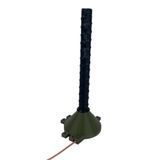
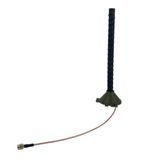
A quadrifilar antenna is a type of helical antenna with four conductive elements arranged around a common axis. The term most commonly refers to a quadrifilar helix antenna, abbreviated as QFH or QHA. Its defining feature is the ability to generate circular polarization while providing a broad spatial radiation pattern.
This design is useful in systems where the relative orientation of transmitting and receiving antennas may change, including satellite communications, telemetry, navigation, and certain unmanned and mobile radio systems. However, the antenna type itself does not determine its operating frequency, gain or compatibility — these parameters depend on the specific design.
What Is a Quadrifilar Helix Antenna?
In a classic configuration, a quadrifilar helix antenna consists of four conductors forming two mutually perpendicular bifilar structures. The elements extend along a cylindrical or near-cylindrical surface and operate together as a single antenna system.
To generate circular polarization, the orthogonal components of the electromagnetic field must be produced with the required phase shift. In a typical QFH design, two pairs of elements are excited in such a way that two mutually perpendicular field components are created with a phase difference of approximately one quarter of a cycle.
Depending on the direction of phase rotation, the antenna can generate right-hand circular polarization, RHCP, or left-hand circular polarization, LHCP. For this reason, antenna selection requires checking not only the operating frequency but also whether the polarization matches the other side of the radio link.
Four Radiating Elements
The symmetrical structure makes it possible to generate two orthogonal field components and form the required spatial characteristics of the antenna.
Circular Polarization
The electric-field vector rotates as the wave propagates, reducing the dependence of the radio link on identical antenna orientation.
Wide Angular Coverage
Many QFH designs provide a broad radiation pattern covering a significant part of a hemisphere, although the exact shape depends on the antenna geometry.
How Circular Polarization Works in a Quadrifilar Antenna
Polarization describes the orientation of the electric field of a radio wave. In a linearly polarized signal, the field vector oscillates mainly in one plane. In a circularly polarized signal, its direction continuously rotates around the propagation axis.
Circular polarization requires two mutually perpendicular field components of approximately equal amplitude with a phase shift close to 90°. This principle forms the basis of the classic quadrifilar antenna design.
In practical systems, polarization is never perfectly circular. Its quality is evaluated using the axial ratio. The closer this value is to 0 dB, the closer the polarization is to ideal circular polarization. An axial ratio of up to 3 dB is commonly used as a practical criterion for the region of effective circular polarization.
RHCP and LHCP: Why Rotation Direction Matters
Circular polarization has a defined direction of rotation. An RHCP antenna is designed for right-hand circular polarization, while an LHCP antenna is designed for left-hand circular polarization. The best polarization matching is achieved when both sides of the radio link use the same polarization.
Antennas with opposite circular polarizations experience significant polarization mismatch. RHCP or LHCP therefore needs to be checked as carefully as operating frequency and connector type.
What Happens When It Is Used with a Linear Antenna?
A circularly polarized antenna can receive a signal from a linearly polarized antenna, but polarization loss occurs. In an ideal case, this difference is approximately 3 dB. Mixing polarization types may therefore be acceptable in some systems, but it should be taken into account when calculating the complete radio link.
Radiation Pattern of a QFH Antenna
One reason quadrifilar antennas are used is their ability to combine circular polarization with a broad radiation pattern. In many QFH designs, maximum radiation or reception occurs along the antenna axis, while the useful coverage extends across a significant part of the upper hemisphere.
The exact pattern is not identical for every quadrifilar antenna. It is affected by:
- the length and shape of the conductors;
- the diameter of the structure;
- the pitch and geometry of the helical elements;
- the feeding and phasing method;
- the operating frequency range;
- the antenna position relative to metal surfaces and other structural components.
The term “quadrifilar antenna” therefore does not imply a specific gain or coverage angle. Selection should be based on the radiation pattern and other specifications of the particular antenna model.
Main Benefits of a Quadrifilar Antenna
Reduced Dependence on Orientation
Linear antennas perform best when their polarization planes are correctly aligned. If one object changes its orientation, polarization matching may deteriorate. Circular polarization reduces this dependence, which can be useful for moving objects or platforms whose orientation changes during operation.
Wide Spatial Coverage
A QFH antenna can operate over a broad range of angles without requiring mechanical tracking of the signal source. This is one reason this antenna type is used in systems receiving signals from objects whose position relative to the antenna changes continuously.
Better Performance in Multipath Environments
In real environments, radio waves can reflect from the ground, buildings, structures and other surfaces. A reflected signal may change its phase and polarization characteristics. In some systems, a properly selected circularly polarized antenna can reduce the influence of unwanted reflected components, although it cannot eliminate multipath propagation completely.
Compact Design for Broad Spatial Coverage
For certain frequencies and designs, a quadrifilar configuration can provide circular polarization and wide angular coverage without requiring a large flat antenna array or a mechanical rotating system. Actual dimensions still depend on wavelength and the specific antenna design.
Limitations of Quadrifilar Antennas
Circular polarization and broad coverage do not make a QFH antenna universal for every radio system. Several characteristics need to be considered before selection.
- Frequency range. Many resonant QFH designs are intended for a specific frequency band and may lose performance outside that range.
- Polarization. RHCP and LHCP are not interchangeable when the other side of the radio link is designed for a specific circular polarization.
- More complex feeding. Correct amplitude and phase excitation of the antenna elements is required to generate proper circular polarization.
- Dependence on installation. Nearby metal structures, housings, cables and other components may affect impedance matching, polarization and the radiation pattern.
- High gain is not always the objective. Wide angular coverage and a narrow directional beam serve different purposes. If operation is required primarily in one known direction, another type of directional antenna may be more appropriate.
Quadrifilar vs Patch vs Linear Antennas: What Is the Difference?
Comparing antennas only by gain is not sufficient. The required polarization, spatial coverage and movement of the objects should be determined first, followed by an assessment of the specifications of particular antenna models.
| Antenna Type | Typical Polarization | Radiation Pattern Characteristics | When It May Be Considered |
|---|---|---|---|
| Quadrifilar QFH | Circular RHCP or LHCP | Often broad hemispherical or near-hemispherical coverage | When antenna orientation changes and broad angular coverage is required |
| Patch Antenna | Linear or circular depending on design | Usually directional into one hemisphere | When compact size, flat construction and a defined operating sector are required |
| Dipole or Monopole | Primarily linear | Broad azimuth coverage depending on installation | For simpler radio systems where polarization orientation can be controlled |
| Directional Antenna | Depends on design | Narrower operating sector with radiation concentrated in a particular direction | When the direction toward the other side of the radio link is known |
The choice between a QFH, patch or linear antenna therefore depends on the application. When wide angular coverage combined with circular polarization is required, a quadrifilar design offers clear functional advantages. When signal energy needs to be concentrated within a limited sector, a directional antenna may be more suitable.
Where Quadrifilar Antennas Are Used
Satellite Communications and Telemetry Reception
A broad radiation pattern combined with circular polarization is well suited to applications where a satellite or another object moves across a large part of the sky. QFH designs are used in various satellite and telemetry systems where signal reception across a wide range of angles is required.
Navigation and Mobile Receivers
Circular polarization is widely used in satellite navigation systems because the relative orientation of transmitter and receiver continuously changes. The exact antenna type depends on the device design, and patch antennas and other compact configurations are also commonly used alongside quadrifilar designs.
Unmanned and Mobile Radio Systems
For moving platforms, circular polarization can be useful where the antenna orientation relative to the other side of the communication link changes during operation. This applies to certain telemetry, data transmission and video communication systems.
However, there is no universal “quadrifilar antenna for a drone.” Compatibility depends on the specific operating frequency, polarization, impedance, connector type, radio module characteristics and other system parameters.
How to Evaluate a Quadrifilar Antenna by Its Specifications
If a QFH antenna is being considered for specific equipment, its external shape alone is not enough to determine suitability. Two visually similar antennas may be designed for different frequency ranges and may have different radiation patterns.
- Check the operating frequency range. It must correspond to the frequencies used by the radio system.
- Match RHCP or LHCP. The direction of circular polarization must correspond to compatible equipment.
- Evaluate the axial ratio. This parameter indicates the quality of circular polarization and should ideally be considered not only at the center frequency but also across the required operating sector.
- Review the radiation pattern. It shows the directions in which the antenna receives or radiates most effectively.
- Check antenna gain. A higher value is not automatically better, because increased gain is often associated with changes in spatial coverage.
- Confirm impedance and connector type. Electrical and mechanical compatibility are as important as polarization.
- Consider installation conditions. Nearby metal surfaces, housings and other antennas may influence actual performance.
Practical guideline: if a product description states only “circular antenna” or “QFH,” this is not enough to confirm compatibility. At minimum, the operating frequency range, RHCP or LHCP polarization, connection type and intended application of the specific model should be known.
Does a Quadrifilar Antenna Need an Amplifier?
A quadrifilar antenna is itself a passive radiating or receiving element unless the specific model contains active electronics. An antenna amplifier performs a different function and is therefore not an inherent or mandatory part of a QFH antenna.
The need for active amplification depends on the architecture of the complete system, cable losses, signal levels and receiver or transmitter characteristics. If the system uses active components, they should be selected according to operating frequency, power requirements, acceptable signal levels and overall compatibility. SKYHUB also offers active antennas and antenna amplifiers, but their use should be determined by the requirements of the specific radio system.
Common Mistakes When Choosing an Antenna
- assuming that every four-element antenna is a quadrifilar QFH design;
- choosing an antenna only by frequency without checking RHCP or LHCP;
- comparing antennas only by their maximum gain;
- ignoring the shape of the radiation pattern;
- expecting all QFH designs to have identical characteristics;
- failing to account for the effect of installation, cable and connectors on overall system performance;
- adding an amplifier without confirming whether it is required by the specific signal path.
What to Consider Before Selecting an Antenna for a Radio System
A quadrifilar antenna makes sense when the application specifically requires the combination of circular polarization and an appropriate spatial radiation pattern. If the primary requirement is operation within one narrow sector, minimum size or linear polarization, another antenna type may be better suited to the task.
In the SKYHUB antennas for drones and radio systems section, you can review available options and compare the specifications of individual models. Before selecting an antenna, check its operating frequency, polarization, connector type, intended application and compatibility with the equipment it will be used with.
For specialized radio systems, equipment should be selected according to its stated purpose, technical documentation and applicable restrictions. The use of radio equipment should comply with applicable legislation and regulations governing the relevant frequency bands.
If it is unclear whether a particular antenna type is compatible with an existing system, prepare the equipment model, operating frequency range, connector type and polarization requirements before selection. These parameters allow compatibility to be assessed without relying on assumptions.
FAQ: Frequently Asked Questions About Quadrifilar Antennas
What is a quadrifilar antenna?
A quadrifilar antenna, also known as a QFH or QHA, is a helical antenna with four conductive elements that can generate circular polarization. It is commonly used where broad angular coverage and reduced dependence on relative antenna orientation are required.
How does a quadrifilar antenna differ from a conventional helical antenna?
A QFH uses four elements arranged to generate two orthogonal field components with the required phase shift. A conventional single-filar helical antenna has a different structure and may produce a different radiation pattern.
Which is better for circular polarization, RHCP or LHCP?
Neither option is universally better. The correct choice is the circular polarization direction that matches the other side of the radio link and the requirements of the specific system.
Is a quadrifilar antenna suitable for UAVs?
It may be suitable for certain unmanned and telemetry systems if its operating frequency, polarization, radiation pattern and connection type are compatible with the equipment. The QFH designation alone does not guarantee compatibility with a particular UAV or radio module.