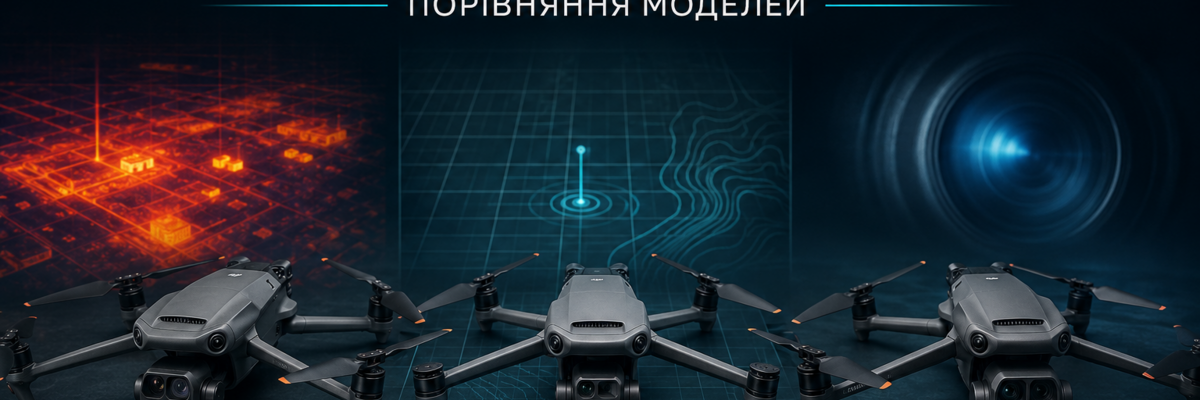
DJI Mavic 3T, Mavic 3E and Mavic 3 Pro are three models designed for different purposes. The Mavic 3T features a thermal imaging camera, the Mavic 3E is designed for mapping and technical surveying, while the Mavic 3 Pro focuses on high-quality photography and video production.
The Mavic 3T and Mavic 3E belong to the Enterprise series and operate within its professional software ecosystem. The Mavic 3 Pro is part of DJI’s consumer product line and is not a direct replacement for the Enterprise models.
A drone should be selected according to its primary task rather than the number of cameras: thermal inspection, accurate mapping or visual content creation. Before placing an order, you should also check the package contents, controller type, accessory compatibility and condition of the specific aircraft.
DJI Mavic 3T, 3E and 3 Pro: Key Differences
The main difference between these models lies in their camera systems and available professional functions. Similar names and airframe designs do not mean that the drones have the same purpose, software or equipment compatibility.
DJI Mavic 3T
A model designed for thermal and visual inspections.
It features a 48 MP wide-angle camera, a 12 MP telephoto camera and a thermal imaging camera with a resolution of 640 × 512 pixels. The model is suitable for facility monitoring, technical inspections, heat-source detection and operations in low-light conditions.
DJI Mavic 3E
An Enterprise model for mapping and regular inspections.
Its main 20 MP 4/3 CMOS camera features a mechanical shutter, while the additional telephoto camera provides hybrid zoom. Support for an RTK module allows the model to be used for high-precision surveying.
DJI Mavic 3 Pro
A camera drone for photography and video production.
The camera system includes a 20 MP Hasselblad 4/3 CMOS main camera, a 48 MP 70 mm medium telephoto camera and a 12 MP 166 mm telephoto camera. The model is designed for shooting at different focal lengths but does not feature a thermal camera or Enterprise functions.
| Parameter | DJI Mavic 3T | DJI Mavic 3E | DJI Mavic 3 Pro |
|---|---|---|---|
| Primary purpose | Thermal monitoring and inspections | Mapping and technical surveying | Photography, video and content creation |
| Camera system | 48 MP wide-angle, 12 MP telephoto, 640 × 512 thermal camera | 20 MP 4/3 CMOS, 12 MP telephoto | 20 MP 4/3 CMOS, 48 MP 70 mm, 12 MP 166 mm |
| Thermal camera | Yes | No | No |
| Mechanical shutter | No | Yes | No |
| RTK | Supports a separate module, but survey-grade accuracy is not guaranteed | Supports a separate module for high-precision surveying | Enterprise RTK is not supported |
| Software platform | DJI Pilot 2 and the Enterprise ecosystem | DJI Pilot 2 and the Enterprise ecosystem | DJI Fly |
| Advertised flight time | Up to 45 minutes with the standard series battery | Up to 45 minutes with the standard series battery | Up to 43 minutes |
The advertised flight time was measured by the manufacturer under controlled conditions. Actual flight duration depends on battery condition, temperature, wind, payload, operating mode and equipment condition. For Enterprise models equipped with the EU C1 battery version, the advertised flight time is up to 36 minutes.
Camera Differences Between the Mavic 3T, Mavic 3E and Mavic 3 Pro
Mavic 3T: Thermal Imaging
The DJI Mavic 3T captures both standard visual and thermal images. Its 640 × 512 thermal camera supports spot and area temperature measurements, making the model suitable for inspecting infrastructure, energy facilities, buildings and hard-to-reach areas.
The wide-angle camera provides an overall view, while the telephoto camera with a 162 mm equivalent focal length helps inspect distant details visually. The advertised 56× zoom is hybrid rather than fully optical.
Mavic 3E: Mechanical Shutter and Mapping
The DJI Mavic 3E features a 20 MP camera with a 4/3 CMOS sensor and mechanical shutter. This design reduces distortion during sequential image capture from a moving platform and makes the model better suited for creating orthomosaics and digital terrain models.
The camera supports interval shooting with intervals as short as 0.7 seconds. A compatible RTK module can be used for tasks requiring more precise positioning, but it must be purchased and checked separately.
Mavic 3 Pro: Three Focal Lengths for Filming
The DJI Mavic 3 Pro offers the most versatile camera system for creative and commercial filming. The main Hasselblad camera with a 24 mm equivalent focal length is designed for detailed shots, the 70 mm camera helps change perspective, and the 166 mm telephoto lens is suitable for capturing more distant subjects.
The main camera records video at up to 5.1K at 50 frames per second and 4K at up to 120 frames per second. Apple ProRes support is available only on the Mavic 3 Pro Cine, so it is important to distinguish between the standard and Cine versions before ordering.
Which DJI Mavic 3 Model Should You Choose?
The right model depends on the result you need to achieve. None of these three drones is equally suited to thermal inspections, precision mapping and professional video production.
- Choose the DJI Mavic 3T if a thermal camera is essential for detecting temperature anomalies, inspecting facilities or monitoring in limited-visibility conditions.
- Choose the DJI Mavic 3E if mapping, photogrammetry, regular inspections and the option to connect an RTK module are your main priorities.
- Choose the DJI Mavic 3 Pro if photo and video quality, multiple focal lengths, colour reproduction and creative shooting modes are more important.
- Consider the Mavic 3 Pro Cine if your workflow requires Apple ProRes recording and higher-capacity internal storage.
Why the Mavic 3 Pro Does Not Replace the Mavic 3E or 3T
The Mavic 3 Pro may outperform the Enterprise models in certain video capabilities, but this does not give it professional Enterprise functions. It lacks the Mavic 3T’s thermal camera, the Mavic 3E’s mechanical shutter, Enterprise RTK support and the DJI Pilot 2 software environment.
The reverse is also true: the Mavic 3T and 3E were not designed to replace the Mavic 3 Pro in video production. Their cameras and software functions are optimised for data collection and analysis rather than maximum creative flexibility.
Controller, Battery and Accessory Compatibility
Belonging to the same product family does not guarantee that all components are interchangeable. The Mavic 3E and Mavic 3T are typically used with the DJI RC Pro Enterprise, while Mavic 3 Pro packages may include the consumer DJI RC, DJI RC Pro or DJI RC-N1 controllers.
The manufacturer specifically states that consumer Mavic 3 Series controllers are not compatible with Mavic 3 Enterprise aircraft. Some batteries and protective components may be interchangeable, but compatibility must be checked using the exact component name and model number.
The RTK module and speaker are Enterprise-series accessories. Both use the same top expansion port, so they cannot be installed simultaneously on the Mavic 3E or Mavic 3T.
Information Needed to Select the Right Model
To compare available packages correctly, it is advisable to determine the following in advance:
- the primary task and expected shooting result;
- whether a thermal camera, mechanical shutter or RTK is required;
- photo, video and file-format requirements;
- the required controller and software platform;
- the number of batteries and required charging equipment;
- whether a new or pre-owned aircraft is acceptable.
What to Check When Choosing a New or Pre-Owned Drone
The model name alone does not reveal the package contents or condition of a specific offer. Before placing an order, check whether the controller, batteries, charger, cables, propellers, carrying case and additional modules are included.
- For a new aircraft: check the exact version, package contents, regional specification and warranty terms.
- For a pre-owned aircraft: check its operating hours, number of battery cycles, repair history and airframe condition.
- For any model: test the gimbal, cameras, obstacle sensors, navigation systems, controller and charging equipment.
- For an Enterprise package: verify compatibility with the RTK module, software and other specialised accessories.
What Determines the Price of the DJI Mavic 3T, 3E and 3 Pro?
The price depends on more than the model name. It is affected by the presence of a thermal camera, camera configuration, Enterprise functions, Pro or Pro Cine version, controller type, number of batteries, charging kit, additional modules and aircraft condition.
Offers can only be compared correctly when their package contents are the same. A lower price may be explained by missing accessories, pre-owned condition or a different controller version, so each package should be checked separately.
Where to Compare DJI Drones and Other Models
Available models and current configurations can be found in the SKYHUB quadcopter and FPV drone category. The availability, condition and contents of each specific offer should be checked on its product page before placing an order.
This article compares stabilised camera drones. If you need a different control method and aircraft design, visit the separate FPV drone category, as their selection criteria differ significantly from those of the DJI Mavic 3 Series.
Help Choosing the Right Model
SKYHUB specialises in quadcopters, FPV drones and related components. When selecting a model, you can clarify the differences between available aircraft, package contents, equipment condition and the compatibility of controllers, batteries or additional modules.
For a consultation, simply provide the intended application, preferred model, camera requirements and a list of equipment you already have.
Important: the purchase and operation of unmanned aircraft must comply with current requirements and restrictions. Before using a drone, check the applicable rules for the selected area, whether flights are permitted and any requirements governing professional operations.
How to Make the Final Decision
If you are choosing between the DJI Mavic 3T, Mavic 3E and Mavic 3 Pro, first identify the essential function: thermal imaging, precision mapping or professional photography and video production. Then confirm the current package contents and equipment compatibility with a SKYHUB specialist.
Frequently Asked Questions About the DJI Mavic 3T, 3E and 3 Pro
What is the difference between the DJI Mavic 3T and DJI Mavic 3E?
The DJI Mavic 3T features a thermal camera, a 48 MP wide-angle camera and a telephoto camera. The Mavic 3E has a 20 MP 4/3 CMOS camera with a mechanical shutter and is better suited for mapping and photogrammetry.
Which is better for photography and video: the Mavic 3 Pro or Mavic 3E?
The Mavic 3 Pro, with its three focal lengths and advanced video modes, is better suited for creative and commercial photography and video production. The Mavic 3E is designed for technical surveying, mapping and data collection.
Do the DJI Mavic 3 Pro and Mavic 3E have thermal cameras?
No. The DJI Mavic 3T features a 640 × 512 thermal camera, while the Mavic 3E and Mavic 3 Pro use visible-light cameras.
Does the DJI Mavic 3E support an RTK module?
Yes. The Mavic 3E supports a separate RTK module and is designed for high-precision surveying. However, final accuracy also depends on the software, settings and correction data used.
Are Mavic 3 Pro and Enterprise-series controllers compatible?
No, they should not be considered interchangeable. DJI states that consumer Mavic 3 Series controllers are not compatible with Mavic 3 Enterprise aircraft, so compatibility must be checked according to the exact model and package configuration.
What should you check before buying a DJI Mavic 3T, 3E or 3 Pro?
Check the exact model, condition, controller, software platform, presence of a thermal camera or RTK module, number of batteries and complete package contents. For a pre-owned aircraft, also check its operating hours, battery cycles and maintenance history.