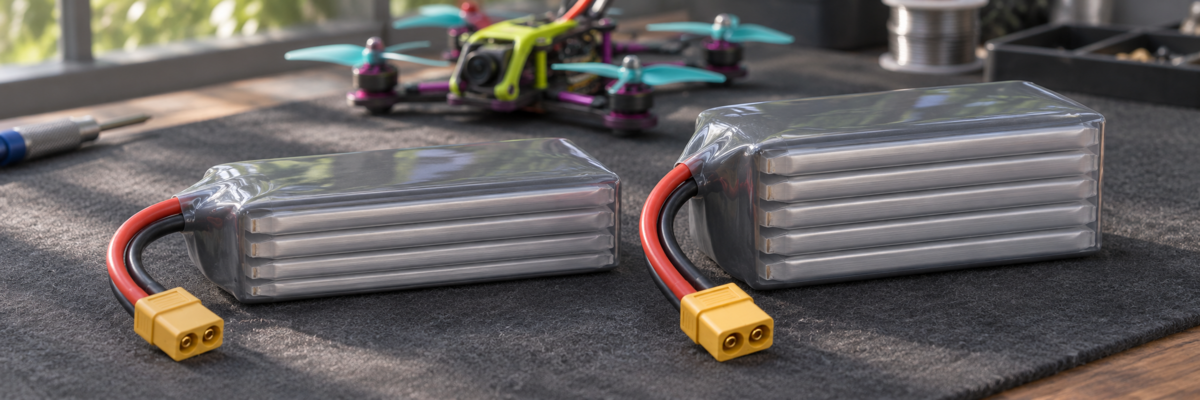
If the manufacturer specifies only a 4S LiPo for your version of the drone, choose a 4S pack. A fully charged standard 4S LiPo supplies 16.8 V, while a fully charged standard 6S LiPo supplies 25.2 V. Even if the plug fits, connecting a 6S pack to a drone rated for 4S can damage its electronics. If the manufacturer supports both, the choice depends on the specifications of the batteries you are comparing and what your charger can handle.
What do 4S and 6S mean on a battery label?
The letter S stands for “series.” A 4S pack has four cells or cell groups connected in series, while a 6S pack has six. When cells are connected in series, their voltages add up. A standard LiPo cell has a nominal voltage of 3.7 V and reaches 4.2 V at full charge.
| Specification | 4S LiPo | 6S LiPo |
|---|---|---|
| Nominal voltage on the label | 14.8 V | 22.2 V |
| Voltage at full charge | 16.8 V | 25.2 V |
| Nominal energy for a 1,000 mAh pack | 14.8 Wh | 22.2 Wh |
The two voltage figures tell you different things. Nominal voltage helps you identify a standard pack configuration and calculate its energy rating. Full-charge voltage tells you what the drone’s electronics will receive when you connect a freshly charged pack. That is why a 6S LiPo labeled 22.2 V can read 25.2 V after charging. The E-flite LiPo battery guide lists these voltages for standard LiPo packs.
How to check which battery your drone supports
Start with the manual for your exact FPV drone model and version. For example, if the specifications for the complete drone say “4S–6S LiPo,” the manufacturer supports both 4S and 6S packs. If that rating appears only on the electronic speed controller (ESC), it applies only to that component. You still need to check the rating for the complete drone.
- Check the model and version. Look up the battery chemistry, supported cell count and recommended pack specifications in the manual. The original battery label can help you identify a suitable replacement. Before switching from 4S to 6S, confirm that the manufacturer supports 6S for your exact version of the drone.
- Read the battery label. A product name may say only “6S,” so check the specifications for the cell chemistry. LiPo, LiHV and lithium-ion packs can all carry a 6S label. Their maximum charge voltage and discharge current ratings can differ.
- Check the connector, polarity, dimensions and weight. Batteries with different voltages can use the same power connector. Once you have confirmed electrical compatibility, check that the pack fits the mounting space and that its weight falls within the drone manufacturer’s recommendations.
- Check the charger separately. Its manual should confirm support for the battery chemistry, the number of cells in series and the balance-charging connection the pack requires. A charger rated for up to 4S cannot charge a 6S pack.
When browsing drone and FPV batteries at SKYHUB, compare each pack’s specifications with your drone manual. If a listing gives the voltage and capacity but omits the dimensions or connector type, use the product code to confirm the missing detail before ordering.
Which pack should you choose if your drone supports both 4S and 6S?
To compare the energy ratings of two compatible packs, convert capacity from milliamp-hours (mAh) to amp-hours (Ah), then multiply by nominal voltage. The result is energy in watt-hours (Wh). This is particularly useful when one pack has a higher mAh rating and the other has more cells in series.
Worked example using the battery labels
A 1,500 mAh 4S LiPo holds 14.8 V × 1.5 Ah = 22.2 Wh of nominal energy.
A 1,000 mAh 6S LiPo holds 22.2 V × 1.0 Ah = 22.2 Wh of nominal energy.
These packs have the same nominal energy rating. Comparing only the 1,500 mAh and 1,000 mAh figures could lead you to assume that the first pack stores more energy.
Two packs with the same watt-hour rating can still give different flight times. Battery weight, the drone’s actual power consumption and the condition of the cells all affect the result. If the manufacturer recommends both 4S and 6S packs, start by comparing their weights and dimensions and checking that each meets the drone’s current requirements. If you already own a compatible 4S charger, a recommended 4S pack may be the practical choice. A 6S pack makes sense when you have identified a specific compatible battery that meets your requirements.
Once you know the supported cell count, SKYHUB’s guide to comparing FPV battery capacity, discharge current and connectors can help you narrow down the remaining options.
Why the difference between LiPo and LiHV matters
The table above applies to standard LiPo packs with a maximum charge voltage of 4.2 V per cell. For some high-voltage lithium-polymer (LiHV) packs, the manufacturer specifies 4.35 V per cell. A 6S pack with that rating reaches 26.1 V at full charge. If your drone supports a standard 6S LiPo, check separately whether it can accept a fully charged 6S LiHV pack.
Choose the charging profile specified on the battery label. Using a LiHV profile for a standard LiPo can overcharge the pack and cause a fire. The charging parameters table in the Onyx charger manual shows how the profiles differ. If the label has worn off and you cannot identify the exact battery model, leave the pack uncharged until you can identify it.
Frequently asked questions about 4S and 6S LiPo batteries
Can I use a 6S battery instead of a 4S if the plug fits?
Only if the drone manufacturer supports 6S for your exact version and the pack meets the other battery requirements. A matching plug tells you nothing about whether the electronics can handle the 25.2 V supplied by a fully charged standard 6S LiPo.
Can I use a 4S LiPo in a drone labeled 6S?
Check the minimum supported battery voltage or cell count in the drone manual. If the manufacturer lists only 6S, support for 4S is unconfirmed.
Why does my 14.8 V battery read 16.8 V after charging?
On a standard 4S LiPo, 14.8 V is the nominal voltage. At full charge, each of the four cells in series reaches 4.2 V, giving a total of 16.8 V.
Can I charge 4S and 6S LiPo batteries with the same charger?
Yes, one pack at a time, if the charger supports standard LiPo batteries at both cell counts and has compatible connections for each pack. Before charging, check the selected profile and cell count against the battery label.