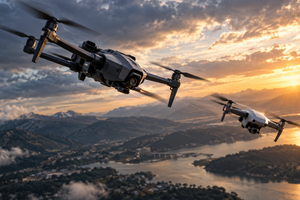
A UAV is an unmanned aerial vehicle: an aircraft that flies without a pilot on board. It may be controlled remotely by an operator, while onboard automation can handle certain functions or carry out a flight task. UAVs include compact quadcopters, unmanned fixed-wing aircraft and helicopter-type platforms.
Drones are classified by their design, intended use, control method, weight and other characteristics. A single aircraft can belong to several categories at once: for example, it may be an electric quadcopter with FPV control designed for video production.
UAV, Drone and Unmanned Aircraft System: What Do These Terms Mean?
In aviation, the terms “drone” and “unmanned aircraft” generally refer to a UAV. However, “drone” also has a broader meaning and can describe uncrewed ground or marine vehicles. “Unmanned aerial vehicle” is therefore a more precise term when referring specifically to an airborne platform.
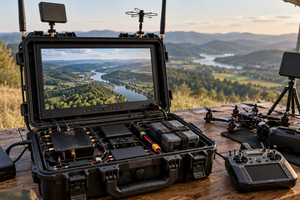
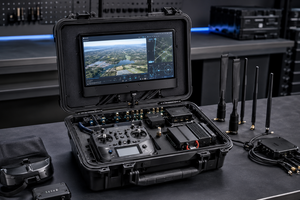
UAV stands for Unmanned Aerial Vehicle. UAS, or Unmanned Aircraft System, refers to the aircraft together with the equipment needed to operate it.
Ukrainian technical materials also use terms equivalent to “unmanned aviation system” and “unmanned aviation complex,” the latter abbreviated as BpAK in Ukrainian. Such a complex may include aircraft, control equipment, communication systems, launch equipment and ground support equipment. Its exact configuration is defined in the documentation.
This distinction matters when comparing offers: a standalone UAV, a ready-to-fly package and a complete system with a ground station contain different equipment.
Main UAV Types by Aircraft Design
An aircraft’s design determines how it generates lift, takes off and moves through the air. Common configurations include multirotor, fixed-wing, helicopter-type and combined designs with vertical take-off and landing capability.
| Type | Design Feature | Typical Capability | Key Consideration |
|---|---|---|---|
| Multirotor | Multiple lifting rotors | Vertical take-off and hovering | The rotors must run continuously to maintain flight |
| Fixed-wing | Stationary wings | Energy-efficient forward flight | A conventional fixed-wing design cannot hover |
| Helicopter-type | A main rotor or a helicopter-style lifting rotor arrangement | Hovering and vertical take-off and landing | Platform-specific mechanical and maintenance requirements |
| Combined fixed-wing VTOL | Wings combined with a vertical lift system | Vertical take-off followed by wing-borne flight | Design complexity and transitions between flight modes |
Multirotors: Quadcopters, Hexacopters and Octocopters
These names indicate the number of lifting rotors: a quadcopter has four, a hexacopter has six and an octocopter has eight. A quadcopter is a type of multirotor UAV, rather than a category separate from unmanned aircraft.
More rotors do not automatically guarantee greater payload capacity, longer flight time or the ability to continue flying safely after a motor failure. These capabilities depend on the overall design and must be confirmed by the manufacturer.
Unmanned Fixed-Wing Aircraft and Combined Platforms
Fixed-wing aircraft use their wings to generate lift as they move through the air. Flying-wing designs also belong to this category. Launch and landing methods depend on the model and its equipment.
VTOL stands for vertical take-off and landing. It describes a capability, rather than one specific aircraft design. Multirotors can also take off vertically, but in descriptions of fixed-wing platforms, VTOL often highlights the combination of vertical take-off and subsequent wing-borne flight.
Drone Types by Intended Use
A similar appearance does not mean similar capabilities. A UAV’s intended use depends on its equipment, software and the results it is designed to deliver.
- Photography and filming drones. Used to capture photos and video. Relevant features include the camera, image stabilisation and available recording modes.
- Mapping and surveying drones. Collect data for maps, terrain models and measurements. The accuracy of the finished output also depends on survey methods and data processing.
- Inspection and monitoring drones. Help inspect structures, infrastructure and natural areas. Depending on the task, they may use visible-light cameras, thermal cameras or other sensors.
- Agricultural drones. Used to monitor crops or perform specialised agricultural work. A drone for surveying a field and a platform for applying agricultural products require different equipment.
- Cargo and logistics drones. Designed to transport loads within their permitted weight limits and operating conditions.
- Training and sports drones. Used for learning to fly, racing and freestyle flying.
- Military drones. Include reconnaissance, surveillance, logistics, communications relay and strike systems. This classification concerns function, rather than rotor count or the presence of FPV equipment.
A further distinction is made between reusable aircraft and single-use systems. This is another independent characteristic: it does not determine the aerodynamic design or control method.
Military use does not make all platforms technically identical. This category is discussed in more detail in the article on military quadcopters and their characteristics.
FPV Drones and Quadcopters: Why These Terms Overlap
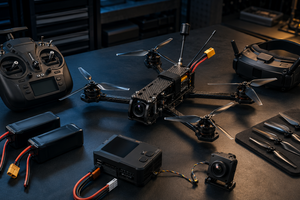
FPV stands for First Person View. The operator receives an image from an onboard camera through goggles or a screen and uses it to pilot the aircraft. FPV describes how the pilot views the flight, while “quadcopter” describes the aircraft’s construction.
A quadcopter can therefore be an FPV drone. FPV equipment can also be used on a fixed-wing platform. Having a camera that records video does not necessarily mean an aircraft has a video transmission system suitable for FPV piloting.
FPV is not synonymous with a strike drone or a single-use aircraft: this piloting method is also used for racing, freestyle flying and filming. For a closer look at the term, read what an FPV drone is.
Classification by Control Method and Level of Automation
The absence of a pilot on board does not mean there is no human involvement in controlling the aircraft. Even a drone with numerous automatic functions may require continuous operator supervision.
Remote Control
The operator sends commands through a control system. Onboard electronics may stabilise the aircraft or help maintain selected flight parameters.
Automatic Flight
The UAV follows a predefined programme or route while the operator retains the ability to intervene. The extent of automation depends on the system.
Autonomous Flight
The system conducts a flight without pilot intervention within its designed capabilities. A drone should not be described as autonomous simply because it has an autopilot.
Automatic return, altitude hold and obstacle avoidance are individual functions. None of them alone confirms full autonomy or the ability to operate safely in every situation.
Weight, Range and Power: Other Ways to Classify UAVs
Size and Take-off Weight
Terms such as “micro,” “mini,” “small” and “heavy” appear in different classification systems, but their boundaries are not universal. Numerical ranges need to be considered alongside the standard or classification system they come from.
It is also important to distinguish the weight of the aircraft itself from its take-off weight with the battery and equipment installed. Maximum take-off weight is not the same as permitted payload weight.
Range and Flight Endurance
Communication range, total flight distance and operating radius with a return flight are different measurements. A stated signal transmission range does not mean the aircraft can travel that distance, complete its task and return.
Meaningful comparisons require the test conditions: payload, speed, weather, battery condition and equipment configuration. A flight-time figure measured without a payload should not be directly compared with a result from another aircraft carrying additional equipment.
Propulsion and Power Systems
UAVs may use electric propulsion, an internal combustion engine or a hybrid power system. The power system affects maintenance, preparation and operating characteristics, but it does not determine performance on its own.
A hybrid power system and a combined aerodynamic design are different concepts. For example, a fixed-wing VTOL aircraft can be entirely electric.
How to Read a Drone Description
The phrase “professional drone” tells you very little about specific capabilities. A useful description should answer several questions:
- What is the aircraft design? Multirotor, fixed-wing, helicopter-type or a combined platform.
- What is it intended for? Filming, measurements, inspections, transport or another defined function.
- What is included? The aircraft, controller, batteries, charger, camera and other equipment should be checked against the actual package contents.
- Which capabilities are confirmed? Control modes, compatibility and permitted payload should be specified in the documentation.
- Under what conditions were the specifications measured? This is particularly relevant to flight time, range and weather limitations.
A payload is equipment or cargo carried to perform a task, such as a camera, a measurement sensor or an item being transported. Spare weight capacity alone does not confirm compatibility: suitable mounting, power supply and control-system support may also be required.
To compare specific platforms, review the specifications in SKYHUB’s Quadcopters and FPV Drones and FPV Drones categories. Confirm the intended use and package contents for each model.
The purchase and use of specialised UAVs must comply with applicable laws and current restrictions. Before operating an aircraft, check whether flights are permitted in the relevant area. Professional equipment selection and operator training should match the type of platform.
FAQ: Frequently Asked Questions About UAVs
Does every UAV have a camera?
No. A camera is not a defining feature of a UAV: the aircraft may carry other sensors or cargo, and some training models have no imaging equipment at all.
Can all drones hover in place?
No. Multirotor and helicopter-type aircraft can hover, as can combined platforms designed for this capability. A conventional fixed-wing UAV needs movement relative to the air to maintain flight.
Can you judge a drone’s capabilities by its size alone?
No. Size alone does not provide enough information about flight endurance, payload capacity or image quality. You need the specifications for the particular model and the conditions under which they were measured.
Does an autopilot make a drone fully autonomous?
No. An autopilot may stabilise the aircraft or follow a predefined route under operator supervision. Full autonomy requires much broader system capabilities and cannot be inferred from individual automatic functions.