


|
Quantity
|
Out of stock
|
||
|
|
|||
|
|
|||
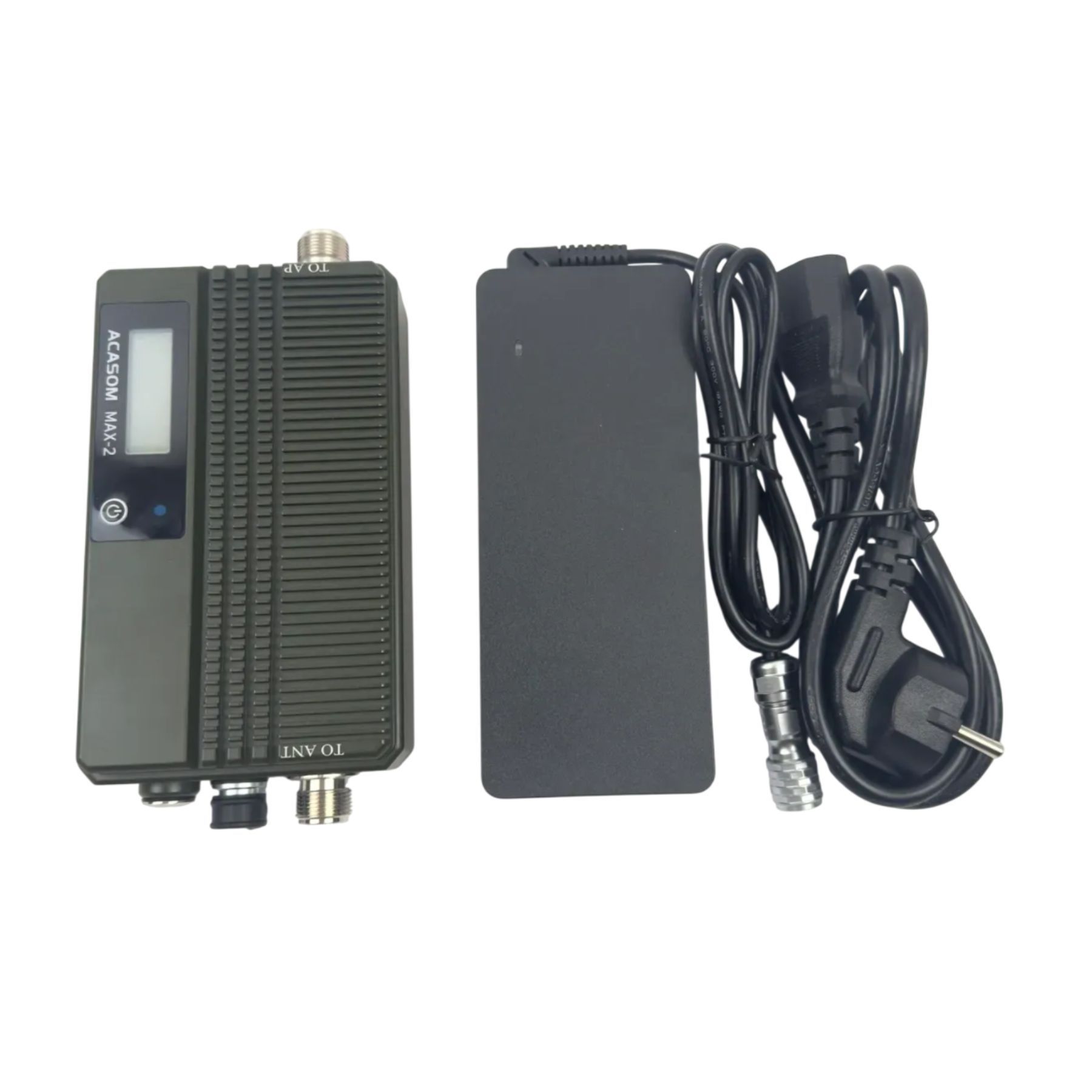
ACASOM 2.4G 10W Communications Repeater: Ultimate Control Channel Gain and Protection
In today's electronic warfare environment, control channel stability and video stream clarity are critical success factors. The ACASOM 2.4G Repeater is a 10W (40 dBm) active tactical amplifier specifically designed to ensure reliable communications in intense EW environments and at extreme flight distances.
Why is ACASOM 2.4G critical for modern aerial reconnaissance?
The 2.4 GHz band remains the primary band for controlling most commercial and specialized drones. However, the standard power of remote controls is often insufficient to penetrate electronic jamming zones. ACASOM 2.4G provides 18 dB of gain, which not only increases the range, but also guarantees signal stability in places where other systems lose the link.
Key tactical advantages:
- Breakthrough of electronic warfare: The output power of 10 W allows the signal to dominate the airwaves, overcoming enemy jamming.
- Minimal latency: The switching speed between receive and transmit modes (TX/RX) is less than 1 μs, which eliminates “input lag” when controlling the drone at high speed.
- High sensitivity: A noise figure of less than 2.5 dB allows the device to capture and amplify even a very weak signal from a UAV returning from deep behind enemy lines.
- Operator safety: Using a repeater allows the antennas to be placed at a considerable distance from the pilot, masking his position and ensuring operation from protected shelters.
Technical and tactical characteristics (TTX)
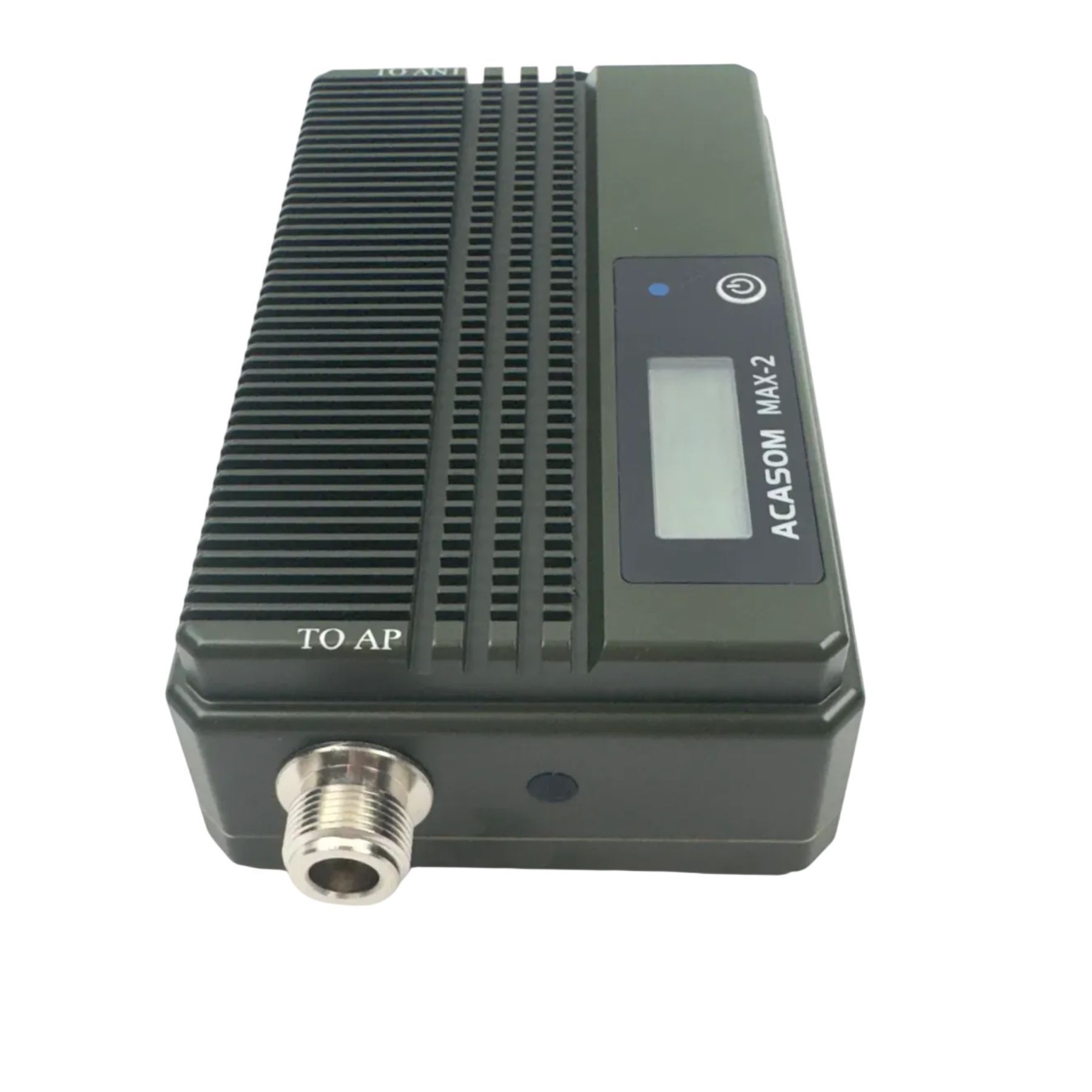
The device is designed in a compact aluminum case, which effectively acts as a radiator for heat dissipation during prolonged operation at maximum power.
| Parameter | Characteristic value |
|---|---|
| Frequency range | 2400-2500 MHz (standard 2.4G) |
| Maximum output power | 10 W (P1dB ≈ 40 dBm) |
| Gain | ≈ 18 dB ±1 |
| Noise figure | < 2.5 dB |
| TX/RX switching delay | < 1 μs (instantaneous response) |
| Operating voltage | 22.2 V (compatible with tactical batteries) |
| Protection class | IP68 (complete protection from water and dust) |
| Case material | Anodized aluminum |
| Weight and dimensions | 1.5 kg / 174 × 87.5 × 44.5 mm |
Design and Reliability: Ready for Extreme Loads
The ACASOM repeater is designed for operation in harsh field conditions. The IP68 protection class allows the equipment to operate uninterruptedly during rainstorms, in dusty forest belts, or in high humidity conditions.
Operating Features:
- Temperature Endurance: Stable operation at temperatures from -30 °C to +70 °C. The aluminum housing prevents the amplifier from overheating even during intensive data transmission.
- Energy efficiency: The operating voltage of 22.2 V allows for easy integration of the repeater into standard power systems of modern ground control stations.
- Compactness: Its low weight (1.5 kg) and thoughtful dimensions make it convenient for quick deployment and rapid change of positions.
Important: Thanks to the high P1dB indicator, the repeater maintains gain linearity even with high-power incoming signals, which is critical for maintaining the quality of the high-definition video stream.
Conclusion: Your technological superiority
ACASOM 2.4G (10 W) is professional equipment for aerial reconnaissance units and UAV strike groups. It provides that very "technological advantage"which allows you to perform tasks at extreme distances while maintaining drone control and pilot safety.
Tactical FAQ: Six Questions About the ACASOM 25W "Heavy" Booster
1. Why is 25W of power at 2.4GHz considered "extreme"?
Most boosters produce 2-10W. The ACASOM 25W is the anti-aircraft searchlight of the communications world. This kind of power allows you to "burn through" enemy electronic warfare jamming at distances where regular drones would fall immediately. In Bannerlord, this would be a heavy cavalry charge, sweeping away everything in its path.
2. What real range advantage does this repeater provide?
You can count on a stable connection at a distance of 15-25 km. But stability is more important: where a regular jammer cuts off the video, this repeater keeps the picture clear, allowing you to guide the drone to the target through a radio storm.
3. How does using ACASOM save the operator from direction finding?
The repeater is remote. You connect it with a cable (10-20 m) and take it out to the mast, while you remain in cover. Enemy reconnaissance sees the repeater's radiation, not your location. Like in photography: a camera on a tripod with a remote release — You're safe, the shot's taken.
4. Will such a strong signal affect Starlink and Wi-Fi?
Because of the 25W power, local Wi-Fi nearby will "go down". But Starlink operates at 10-12 GHz frequencies, which this device does not affect. Your internet for study or communication will remain stable. The main thing is not to point the antenna beam directly at the Starlink dish.
5. Powering the system in the field?
You need a stable voltage of 24 V or 28 V. Your EcoFlow Delta 2 will cope perfectly. The device gets very hot (like an ASUS TUF in a heavy skating rink), so ensure free airflow to the aluminum radiator case.
6. The main "fatal" mistake when working with ACASOM?
Never turn on the power without the antenna connected. The energy from the 25-watt module will return and burn it out instantly. It's like a medical coagulator without grounding—fatal to equipment. First the antenna cable, then the power supply.
Tactical FAQ: Six Questions About the ACASOM 25W "Heavy" Booster
1. Why is 25W of power at 2.4GHz considered "extreme"?
Most boosters output 2-10W. The ACASOM 25W is the anti-aircraft searchlight of the communications world. This kind of power allows it to "burn through" enemy electronic warfare jamming at ranges where regular drones would fall immediately. In Bannerlord, this would be a heavy cavalry charge, sweeping away everything in its path.
2. What real range advantage does this repeater provide?
You can count on a stable connection at a distance of 15-25 km. But stability is more important: where a regular jammer cuts off the video, this repeater keeps the picture clear, allowing you to guide the drone to the target through a radio storm.
3. How does using ACASOM save the operator from direction finding?
The repeater is remote. You connect it with a cable (10-20 m) and take it out to the mast, while you remain in cover. Enemy reconnaissance sees the repeater's radiation, not your location. Like in photography: a camera on a tripod with a remote release — You're safe, the shot's taken.
4. Will such a strong signal affect Starlink and Wi-Fi?
Because of the 25W power, local Wi-Fi nearby will "go down". But Starlink operates at 10-12 GHz frequencies, which this device does not affect. Your internet for study or communication will remain stable. The main thing is not to point the antenna beam directly at the Starlink dish.
5. Powering the system in the field?
You need a stable voltage of 24 V or 28 V. Your EcoFlow Delta 2 will cope perfectly. The device gets very hot (like an ASUS TUF in a heavy skating rink), so ensure free airflow to the aluminum radiator case.
6. The main "fatal" mistake when working with ACASOM?
Never turn on the power without the antenna connected. The energy from the 25-watt module will return and burn it out instantly. It's like a medical coagulator without grounding—fatal to equipment. First the antenna cable, then the power supply.
Tactical FAQ: Six Questions About the ACASOM 25W "Heavy" Booster
1. Why is 25W of power at 2.4GHz considered "extreme"?
Most boosters output 2-10W. The ACASOM 25W is the anti-aircraft searchlight of the communications world. This kind of power allows it to "burn through" enemy electronic warfare jamming at ranges where regular drones would fall immediately. In Bannerlord, this would be a heavy cavalry charge, sweeping away everything in its path.
2. What real range advantage does this repeater provide?
You can count on a stable connection at a distance of 15-25 km. But stability is more important: where a regular jammer cuts off the video, this repeater keeps the picture clear, allowing you to guide the drone to the target through a radio storm.
3. How does using ACASOM save the operator from direction finding?
The repeater is remote. You connect it with a cable (10-20 m) and take it out to the mast, while you remain in cover. Enemy reconnaissance sees the repeater's radiation, not your location. Like in photography: a camera on a tripod with a remote release — You're safe, the shot's taken.
4. Will such a strong signal affect Starlink and Wi-Fi?
Because of the 25W power, local Wi-Fi nearby will "go down". But Starlink operates at 10-12 GHz frequencies, which this device does not affect. Your internet for study or communication will remain stable. The main thing is not to point the antenna beam directly at the Starlink dish.
5. Powering the system in the field?
You need a stable voltage of 24 V or 28 V. Your EcoFlow Delta 2 will cope perfectly. The device gets very hot (like an ASUS TUF in a heavy skating rink), so ensure free airflow to the aluminum radiator case.
6. The main "fatal" mistake when working with ACASOM?
Never turn on the power without the antenna connected. The energy from the 25-watt module will return and burn it out instantly. It's like a medical coagulator without grounding—fatal to equipment. First the antenna cable, then the power supply.
1. Why is 25W at 2.4GHz considered "extreme"?
Most boosters output 2-10W. The ACASOM 25W is the anti-aircraft searchlight of the communications world. This kind of power allows it to "burn through" enemy electronic warfare jamming at ranges where regular drones would fall immediately. In Bannerlord, this would be a heavy cavalry charge, sweeping away everything in its path.
2. What real range advantage does this repeater provide?
You can count on a stable connection at a distance of 15-25 km. But stability is more important: where a regular jammer cuts off the video, this repeater keeps the picture clear, allowing you to guide the drone to the target through a radio storm.
3. How does using ACASOM save the operator from direction finding?
The repeater is remote. You connect it with a cable (10-20 m) and take it out to the mast, while you remain in cover. Enemy reconnaissance sees the repeater's radiation, not your location. Like in photography: a camera on a tripod with a remote release — You're safe, the shot's taken.
4. Will such a strong signal affect Starlink and Wi-Fi?
Because of the 25W power, local Wi-Fi nearby will "go down". But Starlink operates at 10-12 GHz frequencies, which this device does not affect. Your internet for study or communication will remain stable. The main thing is not to point the antenna beam directly at the Starlink dish.
5. Powering the system in the field?
You need a stable voltage of 24 V or 28 V. Your EcoFlow Delta 2 will cope perfectly. The device gets very hot (like an ASUS TUF in a heavy skating rink), so ensure free airflow to the aluminum radiator case.
6. The main "fatal" mistake when working with ACASOM?
Never turn on the power without the antenna connected. The energy from the 25-watt module will return and burn it out instantly. It's like a medical coagulator without grounding—fatal to equipment. First the antenna cable, then the power supply.
1. Why is 25W at 2.4GHz considered "extreme"?
Most boosters output 2-10W. The ACASOM 25W is the anti-aircraft searchlight of the communications world. This kind of power allows it to "burn through" enemy electronic warfare jamming at ranges where regular drones would fall immediately. In Bannerlord, this would be a heavy cavalry charge, sweeping away everything in its path.
2. What real range advantage does this repeater provide?
You can count on a stable connection at a distance of 15-25 km. But stability is more important: where a regular jammer cuts off the video, this repeater keeps the picture clear, allowing you to guide the drone to the target through a radio storm.
3. How does using ACASOM save the operator from direction finding?
The repeater is remote. You connect it with a cable (10-20 m) and take it out to the mast, while you remain in cover. Enemy reconnaissance sees the repeater's radiation, not your location. Like in photography: a camera on a tripod with a remote release — You're safe, the shot's taken.
4. Will such a strong signal affect Starlink and Wi-Fi?
Because of the 25W power, local Wi-Fi nearby will "go down". But Starlink operates at 10-12 GHz frequencies, which this device does not affect. Your internet for study or communication will remain stable. The main thing is not to point the antenna beam directly at the Starlink dish.
5. Powering the system in the field?
You need a stable voltage of 24 V or 28 V. Your EcoFlow Delta 2 will cope perfectly. The device gets very hot (like an ASUS TUF in a heavy skating rink), so ensure free airflow to the aluminum radiator case.
6. The main "fatal" mistake when working with ACASOM?
Never turn on the power without the antenna connected. The energy from the 25-watt module will return and burn it out instantly. It's like a medical coagulator without grounding—fatal to equipment. First the antenna cable, then the power supply.
Most boosters put out 2-10 watts. ACASOM 25W is the anti-aircraft searchlight of the communications world. This kind of power allows you to "burn through" enemy electronic warfare jamming at distances where regular drones would fall immediately. In Bannerlord, this would be a heavy cavalry charge, sweeping away everything in its path.
2. What real range advantage does this repeater provide?
You can count on stable communication at a distance of 15-25 km. But stability is more important: where a regular "jammer" The video cuts out, this repeater keeps the picture clear, allowing you to guide the drone to the target through the radio storm.
3. How does using ACASOM save the operator from direction finding?
The repeater is remote. You connect it with a cable (10-20 m) and take it out to the mast, and you yourself remain in shelter. Enemy reconnaissance sees the repeater's radiation, not your location. Like in photography: a camera on a tripod with a remote release - you are safe, the shot is taken.
4. Will such a powerful signal affect Starlink and Wi-Fi?
Because of the 25 W power, local Wi-Fi nearby will "go down". But Starlink operates at 10-12 GHz frequencies, which this device does not affect. Your internet for study or communication will remain stable. The main thing is not to point the antenna beam directly at the Starlink dish.
5. Powering the system in the field?
You need a stable voltage of 24 V or 28 V. Your EcoFlow Delta 2 will cope perfectly. The device gets very hot (like an ASUS TUF in a heavy roller), so ensure free air access to the aluminum radiator case.
6. The main "fatal" mistake when working with ACASOM?
Never turn on the power without the antenna connected. The energy from the 25-watt module will bounce back and instantly burn it out. It's like a medical coagulator without grounding—fatal to the equipment. First the antenna cable, then the power supply.
Most boosters put out 2-10 watts. ACASOM 25W is the anti-aircraft searchlight of the communications world. This kind of power allows you to "burn through" enemy electronic warfare jamming at distances where regular drones would fall immediately. In Bannerlord, this would be a heavy cavalry charge, sweeping away everything in its path.
2. What real range advantage does this repeater provide?
You can count on stable communication at a distance of 15-25 km. But stability is more important: where a regular "jammer" The video cuts out, this repeater keeps the picture clear, allowing you to guide the drone to the target through the radio storm.
3. How does using ACASOM save the operator from direction finding?
The repeater is remote. You connect it with a cable (10-20 m) and take it out to the mast, and you yourself remain in shelter. Enemy reconnaissance sees the repeater's radiation, not your location. Like in photography: a camera on a tripod with a remote release - you are safe, the shot is taken.
4. Will such a powerful signal affect Starlink and Wi-Fi?
Because of the 25 W power, local Wi-Fi nearby will "go down". But Starlink operates at 10-12 GHz frequencies, which this device does not affect. Your internet for study or communication will remain stable. The main thing is not to point the antenna beam directly at the Starlink dish.
5. Powering the system in the field?
You need a stable voltage of 24 V or 28 V. Your EcoFlow Delta 2 will cope perfectly. The device gets very hot (like an ASUS TUF in a heavy roller), so ensure free air access to the aluminum radiator case.
6. The main "fatal" mistake when working with ACASOM?
Never turn on the power without the antenna connected. The energy from the 25-watt module will bounce back and instantly burn it out. It's like a medical coagulator without grounding—fatal to the equipment. First the antenna cable, then the power supply.
2. What real range advantage does this repeater provide?
You can count on a stable connection at a distance of 15-25 km. But stability is more important: where a regular "jammer" cuts off the video, this repeater keeps the picture clear, allowing you to guide the drone to the target through a radio storm.
3. How does using ACASOM save the operator from direction finding?
The repeater is remote. You connect it with a cable (10-20 m) and take it out to the mast, while you remain in cover. Enemy reconnaissance sees the repeater's radiation, not your location. Like in photography: a camera on a tripod with a remote release - you're safe, the shot is taken.
4. Will such a powerful signal affect Starlink and Wi-Fi?
Because of the 25W power, local Wi-Fi nearby will "go down". But Starlink operates at 10-12 GHz frequencies, which this device does not affect. Your internet for study or communication will remain stable. The main thing is not to point the antenna beam directly at the Starlink dish.
5. Powering the system in the field?
You need a stable voltage of 24 V or 28 V. Your EcoFlow Delta 2 will cope perfectly. The device gets very hot (like an ASUS TUF in a heavy skating rink), so ensure free airflow to the aluminum radiator case.
6. The main "fatal" mistake when working with ACASOM?
Never turn on the power without the antenna connected. The energy from the 25-watt module will return and burn it out instantly. It's like a medical coagulator without grounding—fatal to equipment. First the antenna cable, then the power supply.
2. What real range advantage does this repeater provide?
You can count on a stable connection at a distance of 15-25 km. But stability is more important: where a regular "jammer" cuts off the video, this repeater keeps the picture clear, allowing you to guide the drone to the target through a radio storm.
3. How does using ACASOM save the operator from direction finding?
The repeater is remote. You connect it with a cable (10-20 m) and take it out to the mast, while you remain in cover. Enemy reconnaissance sees the repeater's radiation, not your location. Like in photography: a camera on a tripod with a remote release - you're safe, the shot is taken.
4. Will such a powerful signal affect Starlink and Wi-Fi?
Because of the 25W power, local Wi-Fi nearby will "go down". But Starlink operates at 10-12 GHz frequencies, which this device does not affect. Your internet for study or communication will remain stable. The main thing is not to point the antenna beam directly at the Starlink dish.
5. Powering the system in the field?
You need a stable voltage of 24 V or 28 V. Your EcoFlow Delta 2 will cope perfectly. The device gets very hot (like an ASUS TUF in a heavy skating rink), so ensure free airflow to the aluminum radiator case.
6. The main "fatal" mistake when working with ACASOM?
Never turn on the power without the antenna connected. The energy from the 25-watt module will return and burn it out instantly. It's like a medical coagulator without grounding—fatal to equipment. First the antenna cable, then the power supply.
4. Will such a powerful signal affect Starlink and Wi-Fi?
Because of the 25W power, local Wi-Fi nearby will "go down." But Starlink operates at 10-12 GHz frequencies, which this device does not affect. Your internet for study or communication will remain stable. The main thing is not to point the antenna beam directly at the Starlink dish.
5. Powering the system in the field?
You need a stable voltage of 24V or 28V. Your EcoFlow Delta 2 will cope perfectly. The device gets very hot (like an ASUS TUF in a heavy roller), so provide free air access to the aluminum radiator case.
6. The main "fatal" mistake when working with ACASOM?
Never turn on the power without the antenna connected. The energy of the 25-watt module will return back and burn it out instantly. It's like a medical coagulator without grounding - fatal for equipment. First the antenna cable, then the power.
4. Will such a powerful signal affect Starlink and Wi-Fi?
Because of the 25W power, local Wi-Fi nearby will "go down." But Starlink operates at 10-12 GHz frequencies, which this device does not affect. Your internet for study or communication will remain stable. The main thing is not to point the antenna beam directly at the Starlink dish.
5. Powering the system in the field?
You need a stable voltage of 24V or 28V. Your EcoFlow Delta 2 will cope perfectly. The device gets very hot (like an ASUS TUF in a heavy roller), so provide free air access to the aluminum radiator case.
6. The main "fatal" mistake when working with ACASOM?
Never turn on the power without the antenna connected. The energy of the 25-watt module will return back and burn it out instantly. It's like a medical coagulator without grounding - fatal for equipment. First the antenna cable, then the power.