
|
Quantity
|
Out of stock
|
||
|
|
|||
|
|
|||
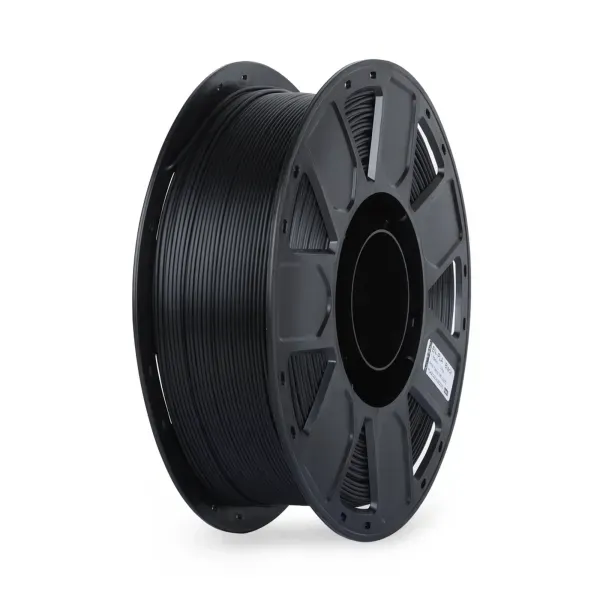
Creality PLA Filament 1.75mm (1kg), Black: Reliable Polymer for Rapid Prototyping
In today's technological warfare, speed of engineering decisions is crucial. Creality PLA plastic is the standard for stability and ease of use. Whether you need to print a student model, a prototype fixture, or an electronics enclosure in a short time, this filament will ensure flawless results on the first try.
Why is Creality PLA the standard for tactical modeling?
PLA (polylactide) is the most popular material for FDM printing due to its predictability. Unlike complex composites, it does not require a closed chamber or high-temperature table, which allows for production even in the field using basic 3D printer models.
- High detail: Ideal for printing complex geometric shapes and small mechanical parts.
- Minimal shrinkage: Parts do not deform during cooling, which guarantees precise dimensional compliance — Critically important for mating components.
- Safety of use: Does not emit toxic odors during printing, which allows working in enclosed spaces (headquarters, dugouts).
- Tactical black color: The matte black shade gives products a professional look and contributes to better camouflage of equipment.
Technical characteristics (TTX) of filament
Creality plastic undergoes strict quality control, which eliminates the presence of air bubbles or differences in filament diameter, preventing the extruder from jamming at the most crucial moment.
| Parameter | Value |
|---|---|
| Material type | PLA (Polylactic Acid) |
| Brand | CREALITY |
| Article | 3301010122 |
| Filament diameter | 1.75 mm |
| Spool weight | 1 kg |
| Thread length | ≈ 335.3 m |
| Print Temperature | 190-220 °C |
| Bed Temperature | Not required (optional 50-60 °C) |
| Compatibility | Most FDM / FFF 3D printers |
Military Engineering Applications
Although PLA is inferior to PETG in heat resistance, its rigidity and printing speed make it indispensable for specific tasks:
- Training Aids: Print mock-ups of ammunition, mines, and explosive devices for personnel training.
- Prototyping: Quickly test concepts for antenna mounts, release systems, or protective covers.
- Organizers and Cases: Create trays for optics, radios, and tools where rigid fixation is required.
- Auxiliary Tools: Marking templates, guides, and clamps for repair work.
Recommendations for Use and Storage
To ensure consistent print quality, adhere to the following tips:
- Adhesion: Using a bed temperature of 50-60 °C virtually eliminates the risk of part delamination from the surface.
- Storage: PLA is hygroscopic. After use, store the spool in an airtight bag with silica gel to prevent the filament from becoming brittle.
- Cooling: Use 100% airflow to achieve the best quality of small details and sharp corners.
Expert opinion: Creality PLA is a reliable solution for quickly visualizing engineering ideas. It is easy to set up and works in any environment where there is a 3D printer. It is the best choice in terms of price and quality for the production of auxiliary accessories.
Conclusion
Creality 1.75mm PLA plastic is an indispensable material for volunteer centers and engineering units. Black color,The filament's diameter stability and ease of printing make it ideal for creating precise mockups and prototypes that bring us closer to victory.
Frequently Asked Questions about ELEGOO PETG (Black)
What makes PETG fundamentally better than the popular PLA?
PETG combines the ease of printing of PLA with the strength and heat resistance of ABS. It is much more flexible (less brittle), has excellent interlayer adhesion, and is resistant to ultraviolet (UV) and water. This makes it the best choice for parts that work outdoors.
What are the optimal temperature settings for ELEGOO PETG?
For consistent results, the following parameters are recommended:
- Nozzle temperature: 230-250°C.
- Table temperature: 70-80°C.
- Blow-off: off for the first layers and minimal (20-50%) for subsequent layers.
How to combat the main problem of PETG - "stringing" (webbing)?
PETG is more viscous by nature. To minimize "hair" on the model, you need to fine-tune the retraction, make sure the plastic is dry, and slightly reduce the print speed for the outer walls.
Is it true that PETG can damage the bed surface?
Yes, it can. PETG has super-high adhesion to glass and PEI. It can literally rip out a piece of glass when cooling. Tip: Always use a glue stick as a release layer to safely remove the model.
Is this plastic suitable for technical parts?
Absolutely. Thanks to its impact resistance and the ability to withstand temperatures up to 70-80°C without deformation, black PETG from ELEGOO is ideal for functional elements, brackets, and housings.
How do you know if plastic is damp and how do you dry it?
Signs of damp PETG: a characteristic cracking sound when printing, bubbles on the surface, and excessive cobwebs. It is recommended to dry it at a temperature of 60-65°C for 4-6 hours.