
|
Quantity
|
Out of stock
|
||
|
|
|||
|
|
|||
Dome Anti-Drone for Cars: 10-Band Anti-FPV System (500W)
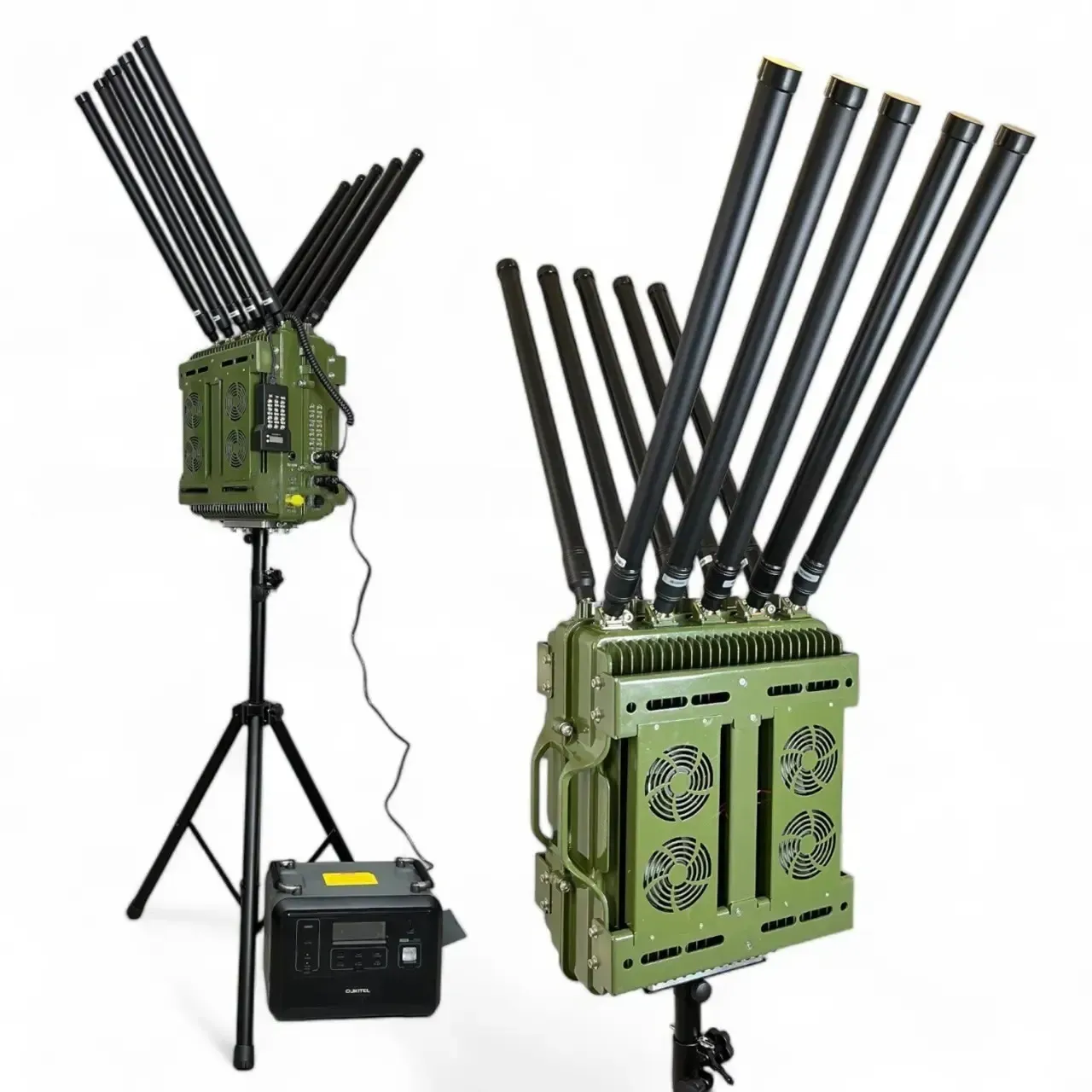
In modern warfare, mobility and electronic security are key factors for survival. The 10-band dome-type vehicle electronic warfare system is the ultimate solution for creating an impenetrable "protective dome" around a vehicle. With a total amplifier power of 500 W, the system guarantees the neutralization of enemy FPV drones and reconnaissance UAVs within a radius of up to 300 meters.
Why are 10 bands the standard for survival in 2026?
The enemy constantly changes control and video communication frequencies, trying to find "gaps" in standard jammers. This system is designed for layered protection, covering not only popular frequencies (800/900 MHz), but also critically low and ultra-high ranges.
- Low-frequency coverage (200-600 MHz): Blocking of custom drones and equipment operating on non-standard frequencies to bypass typical electronic warfare systems.
- Main spectrum (700-1200 MHz): Reliable suppression of the most common control protocols (ELRS, Crossfire) and video telemetry.
- High-frequency protection (2.4 and 5.8 GHz): Complete blocking of video transmission channels and digital Wi-Fi control channels.
Technical and tactical characteristics (TTX)
The system is based on high-strength aluminum alloy and is equipped with collinear antennas on springs, which ensures resistance to mechanical damage when driving off-road.
| Parameter | Characteristic value |
|---|---|
| Number of ranges | 10 independent channels |
| Total amplifier power | 500 W (10 modules of 50 W) |
| Suppression range | 150 - 300 meters (minimum) |
| Power supply system | 12V / 24V (from the on-board battery network) |
| Power consumption | ~ 1200 - 1500 W |
| Housing material | Metal / Aluminum alloy |
| Protection class | IP65 (complete protection against dust and water jets) |
| Operating temperature | -20 ... +55 °C |
| Antenna type | 10 collinear omnidirectional antennas on springs |
Details of suppression frequencies:
Each of the 10 modules with a power of 50 Watt operates independently, creating a high density of interference in its spectrum.
- 200-300 MHz: Protection against custom low-frequency UAVs.
- 300-400 MHz: Suppression of non-standard control channels.
- 400-500 MHz: Blocking the UHF range.
- 500-630 MHz: Closing scarce offset frequencies.
- 630-760 MHz: Enhanced protection of the lower ELRS spectrum.
- 760-900 MHz: The main channel for suppressing FPV kamikazes.
- 900-1050 MHz: Telemetry blocking and video signal.
- 1050-1200 MHz: Protection from shifted control frequencies.
- 2400-2500 MHz: Blocking Wi-Fi control and video channels.
- 5725-5850 MHz: Suppression of high-definition video communication.
Design advantages of vehicle-mounted electronic warfare
This system is specifically designed for operation in harsh field conditions on vehicles of any type.
1. Spring-loaded antenna base
All 10 antennas are mounted on special spring dampers. This allows the vehicle to pass unhindered through forest belts and low obstacles — the antennas simply bend and instantly return to their original position without the risk of breaking or damaging the connectors.
2. Ultimate power and cooling
The total radiated power of 500 W creates such a density of radio interference that it “blinds” the drone even in the presence of a strong signal from the operator. The aluminum body acts as a massive radiator, which, together with active cooling, guarantees stable operation 24/7.
3. Universal power supply (12V / 24V)
The system automatically adapts to the voltage of the on-board network, which allows it to be installed on both light pickup trucks and heavy trucks or armored personnel carriers without the use of additional converters.
Important: Thanks to the IP65 protection standard, the device can operate during heavy rain, snowfall or in very dusty conditions without loss of efficiency.
Conclusion: Full electronic control
10-band dome anti-drone is an investment in the safety of the crew and the integrity of the equipment. No "blind spots" in the frequency spectrum from 200 MHz to 5.8 GHz makes this tool one of the most effective tools in the fight against the modern UAV threat.
Tactical FAQ: Ten questions about the ultimate auto-electronic warfare
1. Why 10 bands? Doesn't the enemy only fly on the 900th frequencies?
In 2026, the frequency war has become chaotic. The enemy uses the "low" (300-600 MHz) and "high" (2.4/5.8 GHz). The 10-band system is a complete suit of armor: it protects against both homemade FPV kamikazes and factory Mavics.
2. What frequencies exactly does this "monster" cover?
This solid shield covers three main echelons:
- Bottom: 300-600 MHz (non-standard FPV).
- Center: 700-1050 MHz (main "kamikaze").
- Top: 2.4 and 5.8 GHz (Mavic control and video).
3. What is the actual power and range of the protective dome?
With 50 watts for each of the 10 modules, the total power is 500 watts. This creates a zone of confident suppression within a radius of 250-500 meters. For medics, this is a huge reserve of time: the drone loses connection long before reaching the attack distance.
4. Can GPS and mobile communications be used under the dome?
The short answer is no. GPS will be jammed by a special module (1.2-1.6 GHz) so that the drones cannot navigate using satellites. The mobile network will also disappear. Starlink is the only way to communicate, it will continue to work perfectly.
5. How to power such an electronic warfare system from the car's on-board network?
The system consumes 1–1.2 kW. A regular generator may not be able to handle it. The best option is a powerful charging station (EcoFlow Delta 2 Max). The system will operate for no more than 20 minutes on the standard car battery.
6. How critical is cooling for 10 modules?
This is a matter of device survival. 10 modules heat up like a powerful heater. Overheating of one module will create a "hole" in the dome through which the drone will fly. Keep your coolers and radiators clean just as carefully as you keep your camera lenses clean.
The system consumes 1–1.2 kW. A regular generator may not be able to handle it. The best option is a powerful charging station (EcoFlow Delta 2 Max). The system will operate for no more than 20 minutes on a standard car battery.
6. How critical is cooling for 10 modules?
This is a matter of device survival. 10 modules heat up like a powerful heater. Overheating one module will create a "hole" in the dome through which the drone will fly. Keep coolers and radiators clean as carefully as you keep your camera lenses clean.
The system consumes 1–1.2 kW. A regular generator may not be able to handle it. The best option is a powerful charging station (EcoFlow Delta 2 Max). The system will operate for no more than 20 minutes on a standard car battery.
6. How critical is cooling for 10 modules?
This is a matter of device survival. 10 modules heat up like a powerful heater. Overheating one module will create a "hole" in the dome through which the drone will fly. Keep coolers and radiators clean as carefully as you keep your camera lenses clean.