


|
Quantity
|
Out of stock
|
||
|
|
|||
|
|
|||
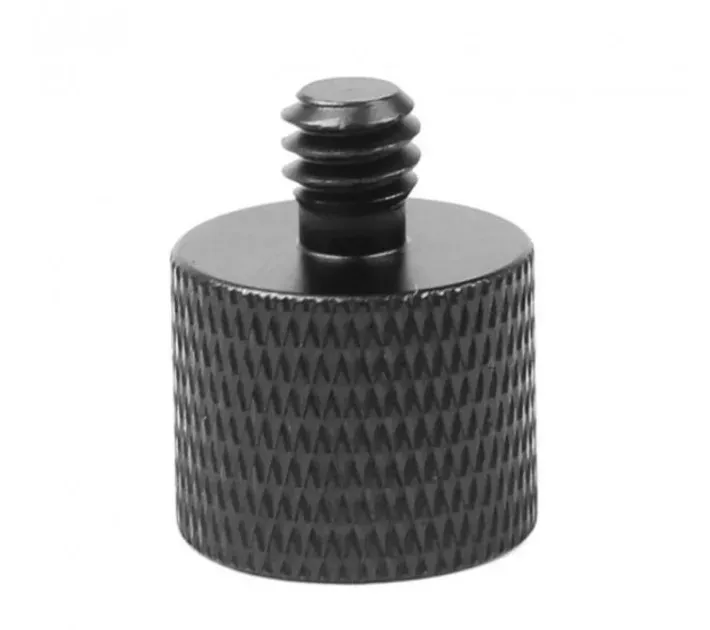
1/4" Male to 3/8" Female Adapter: Universal Tactical Gear Connection
In combat conditions and when performing aerial reconnaissance missions, the reliability of equipment fixation often becomes a critical factor. The 1/4" Male to 3/8" Female Adapter is a compact but indispensable piece of tactical gear. It allows you to instantly adapt professional optical equipment, laser rangefinders, thermal imagers, or antennas to standard tripods, masts, and tripod heads of various standards.
Why is this adapter essential in the arsenal of an aerial reconnaissance and communications specialist?
Most tactical devices use standard "photo threads" 1/4", while professional heavy-duty tripods or specialized military mounts often have a heavy-duty 3/8" thread. This adapter solves the problem of incompatibility, providing a rigid and stable connection without backlash.
- All-metal body: Made of a durable alloy that can withstand significant loads, vibrations and impacts, unlike fragile plastic counterparts.
- Knurled surface: Special notches on the body allow you to securely tighten the adapter even with wet hands or in tactical gloves, which is critical in field conditions.
- Anti-glare coating: The matte black color eliminates the appearance of sun bunnies, providing camouflage for the operator's position.
- Compactness and reliability: Takes up minimal space in the pouch, but allows you to assemble an observation post from improvised means.
Technical and tactical characteristics (TTX) of the adapter
This adapter is designed for systems that require reliable fastening of heavy equipment on tripod heads, platforms or antenna masts.
| Parameter | Characteristic value |
|---|---|
| Adapter type | 1/4" Male (screw) - 3/8" Female (hole) |
| External thread diameter | 1/4" (tripod and camera standard) |
| Internal hole diameter | 3/8" (reinforced standard) |
| Material | High-strength metal |
| Surface Texture | Ribbed (anti-slip) |
| Color | Black (matte) |
Fields of Application on the Front Line
The 1/4" to 3/8" adapter is a small element of a large system that finds application in a wide variety of units:
- Aerial Reconnaissance: Installing remote antenna amplifiers or AvengeAngel antennas on heavy-duty tripods.
- Sniper Crews: Mounting heavy spotting scopes and weather stations on stable platforms.
- Communications: Adapting brackets for repeaters and satellite communication systems.
- Surveillance: Mounting thermal imaging monoculars on tripods for long-term sector monitoring.
Expert opinion: When mounting equipment on high masts or in areas of strong wind, use only metal adapters with a knurled surface. This ensures that the threads will not strip under load, and the expensive device will not fall at the most crucial moment.
Conclusion: Reliability that fits in your pocket
The 1/4" - 3/8" metal adapter is a professional solution for those who value versatility and reliability. The simplicity of the design combined with high-quality materials makes it a must-have in the repair kit and tactical kit of any specialist working with equipment on front.
FAQ: Questions and Answers about the 1/4" (M) - 3/8" (F) Adapter
1.Why do I need this adapter in photography equipment?
There are two thread standards in photography: 1/4 inch (thin, for cameras) and 3/8 inch (thick, for tripod heads and studio lights). This adapter allows you to mount equipment with a small hole (1/4") to a base with a large screw (3/8").
2. How to decipher Male and Female in this adapter?
3/8" Female (female) is the inner hole at the bottom that screws onto the tripod. 1/4" Male (male) is the screw at the top that you attach your camera or smartphone holder to.
3. What material should a high-quality adapter be made of?
Choose only metal (steel or brass). Plastic adapters break under the weight of the camera, and their threads wear out quickly. A metal adapter is a guarantee of the safety of your expensive equipment.
4. Can I put the camera on a studio stand?
Yes! Most heavy-duty stands have a 3/8" screw. With this adapter, you can mount a camera, monitor, or microphone, which have a standard 1/4" jack, on them.
5. Is it reliable for heavy equipment?
An all-metal adapter can withstand a load of several kilograms. This is a reliable solution for most setups, unless you use extremely heavy accessories.
6. Why buy several at once?
They are small and often get lost. In a studio setting, where equipment from different systems is mixed, such an adapter in your pocket is the best way to avoid delays during shooting.
Choose only metal (steel or brass). Plastic adapters break under the weight of the camera, and their threads wear out quickly. A metal adapter is a guarantee of the safety of your expensive equipment.
4. Can I put the camera on a studio stand?
Yes! Most heavy-duty stands have a 3/8" screw. With this adapter, you can mount a camera, monitor, or microphone, which have a standard 1/4" jack, on them.
5. Is it reliable for heavy equipment?
An all-metal adapter can withstand a load of several kilograms. This is a reliable solution for most setups, unless you use extremely heavy accessories.
6. Why buy several at once?
They are small and often get lost. In a studio setting, where equipment from different systems is mixed, such an adapter in your pocket is the best way to avoid delays during shooting.
Choose only metal (steel or brass). Plastic adapters break under the weight of the camera, and their threads wear out quickly. A metal adapter is a guarantee of the safety of your expensive equipment.
4. Can I put the camera on a studio stand?
Yes! Most heavy-duty stands have a 3/8" screw. With this adapter, you can mount a camera, monitor, or microphone, which have a standard 1/4" jack, on them.
5. Is it reliable for heavy equipment?
An all-metal adapter can withstand a load of several kilograms. This is a reliable solution for most setups, unless you use extremely heavy accessories.
6. Why buy several at once?
They are small and often get lost. In a studio setting, where equipment from different systems is mixed, such an adapter in your pocket is the best way to avoid delays during shooting.